Stories / Act One
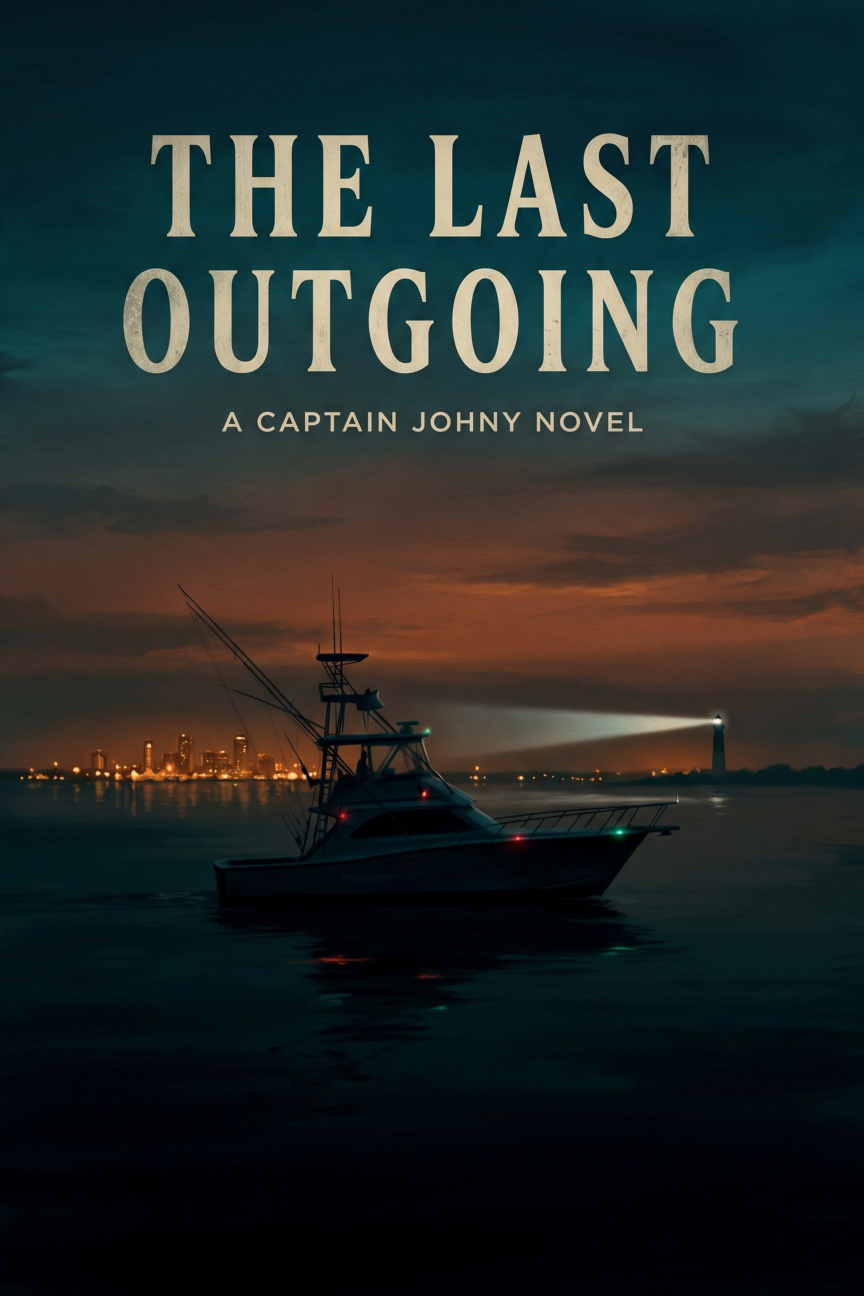
The Last Outgoing
A 1979 Bertram named Wasn't Me, a tick that is not the fuel pump, and one outgoing tide that pays like six months. Act One, complete.
Chapter One — Wasn't Me
The port engine started making a new noise four miles off Egmont Key, on a Tuesday, with three insurance adjusters from Dayton in my cockpit and one of them already committed to being sick.
It wasn't a bad noise yet. Bad noises announce themselves. This one was more of a suggestion — a small tick down under the deck plates, patient and regular, like a man at the back of a church who knows a secret and is willing to sit through the whole service before he tells it.
I did what any professional would do with a noise like that. I turned up the radio.
"You hear that?" Marco said.
Marco is twenty-two and takes two classes at Hillsborough Community College, both of which he reports are going great in a tone that suggests litigation. He calls everybody chief. Me, his mother, the guy at the parts counter, and one time, with real feeling, a manatee.
"Hear what," I said.
"That tick."
"Fuel pump."
"That ain't the fuel pump."
"It's the fuel pump, Marco."
He gave me the look you give a man who has just told you the check is in the mail, and then he went aft and baited a rod for the adjuster named Dale, who had been holding the port rail for eleven minutes with the expression of a man reading his own obituary and finding a typo in it.
The other two were named Gary and Other Gary. That's not a joke I made up to be charming; that's what they called each other, and by nine in the morning I had stopped fighting it. Gary had a hat from a golf course in Naples he wanted me to know about.
Other Gary had brought his own cooler, which is a thing people do when they've been on a boat once and formed opinions. It was October, which in Tampa means the summer has agreed to negotiate. The bay had that hard flat shine it gets before the wind fills in, and the sky over the Skyway was doing something in peach and gunmetal that I've been looking at for twenty-two years and have not yet gotten around to being tired of. Somewhere south of us a freighter was coming up the channel at the speed of a decision being made by committee. "Captain," Gary said, "we gonna catch something or we sightseeing?"
"Both," I said. "Sightseeing's included."
"What's the fishing cost, then?"
"Eight hundred," I said. "Sightseeing's what you get for free." Other Gary thought that was funny, which I appreciated, because I have been telling that one since the second Bush administration and it has begun to develop a limp. We got into kingfish about twenty minutes later, which saved my life in the sense that a charter is really just a four-hour argument you win or lose in the first hour. The first fish went off Dale's rod and the boat did what boats do — everybody forgot they had a spine or a mortgage and turned into a crowd at a parade. Dale stopped being sick. That's the thing nobody puts in the brochure. A man can be sick for an hour and cured in a second, and the medicine costs four ounces of something silver going the other direction.
He fought it badly and beautifully, and when Marco got the gaff in and swung it over the rail, the fish came aboard in a long sideways commotion of chrome and bad intentions, and Dale from Dayton, Ohio, an adjuster of claims, made a noise I hadn't heard a grown man make since my father watched the Bucs beat somebody they had no business beating.
"That's a fish," I said.
"That's a fish," Dale agreed.
Gary got one. Other Gary got two, including the big one, which is a violation of the natural order of charters — the loudest man is not supposed to be rewarded — but the Gulf doesn't take suggestions.
And under all of it, the whole four hours, patient as a Baptist: tick. tick. tick.
* * *
The run in was flat and gold. That's the part I'd sell if I could figure out how to package it. Everybody's sunburned and quiet, the fish are in the box, somebody's got a beer sweating on the gunwale, and the city comes up out of the water in front of you like it's just been invented — the Bayshore curve, the sailboat masts stacked up at Davis Islands, the downtown glass catching the last of it and throwing it back at you as though it were doing you a favor.
Marco was hosing down the transom. Dale came up and stood beside me at the helm, hanging on to the grab rail the way first-timers do, like the boat might go somewhere without him. "Do you ever get used to this?" he said.
People ask me that about twice a month. The honest answer is complicated and involves my bank account, my back, and a marine diesel mechanic named Lloyd who I owe money to and who has a laugh I hear in my sleep.
"Not so far," I said, which was also true, and shorter. He nodded and looked out at it and didn't say anything else, which put him in the top ten percent of people I have taken fishing.
They tipped well. Insurance men usually do — they spend their whole lives assigning a number to things that can't be replaced, and I think it gives them a soft spot for anybody who's clearly operating at a loss. Gary shook my hand with both of his and told me he was going to look into boats. He will not look into boats. That's fine. It's a nice thing to say on a dock at five in the afternoon with your face full of sun, and I've said worse things at that hour.
Then they walked up the pier toward the parking lot in their new hats, and the noise from the port engine, which had been a suggestion all day, cleared its throat and made a proposal. * * *
I've had the Wasn't Me since 2011. She's a 1979 Bertram 31, which to the uninitiated is a boat and to the initiated is a diagnosis. I bought her from a dentist in Apollo Beach who was in the third act of a divorce and wanted her gone the way you want a tooth gone. He came down to the dock to hand me the keys and stood there for a minute with his hand on the cabin roof, and then
he said, "She'll take anything you point her at," and got in his car and drove away, and I have thought about that sentence roughly nine thousand times since.
The name came with her. I have been asked about it every single working day for fifteen years, and I have never once been the first person to think of the joke.
"Wasn't me," Bett Alvarez said, when I came up the pier with the fish box.
"Every time."
"One of these days I'll surprise you."
"Don't. It's the only stable thing in my life."
Bett runs the fish house at the end of Ballast Point, which is a plywood counter, three coolers, a scale that has been legally certified since before the moon landing, and the best smoked mullet dip on this side of the state — a claim I will defend in any parking lot of your choosing. She is sixty-one and has forearms like a longshoreman and reading glasses on a chain, and she has been standing in that same eight feet of shade so long that the county has essentially given up on making her leave. She weighed the kings and wrote it in the book, and while she wrote it she didn't look up.
"Lloyd came by," she said.
"Did he."
"He said he'd stop by your slip but he didn't want to embarrass you in front of a charter."
"That's very sensitive of Lloyd."
"He wanted me to tell you he's not mad."
"Lloyd's never mad."
"No," she agreed. "That's the worst part about him." She tore off my copy of the ticket and held it out and finally looked up over the glasses.
"How's the port engine, Johny."
Ballast Point has maybe forty regulars, and every one of them can hear the difference between a Detroit that's happy and a Detroit that's thinking about something. I'd run in past the fish house at idle. She'd have heard it through a wall and a window unit.
"It's got a tick," I said.
"Mm."
"It's the fuel pump."
Bett took her glasses off, which she does the way other people crack their knuckles.
"Sure," she said. "It's the fuel pump."
* * *
It was not the fuel pump.
Lloyd got there at seven the next morning, which is a violation of everything I know about marine mechanics, and stood in my engine room for forty minutes with his head cocked like a bird that's heard something in the grass. Then he came up into the cockpit and sat on my fish box and wiped his hands on a rag that made them worse.
Lloyd Petrakis has been putting his hands inside boats in Hillsborough County since 1984. He's got white hair he cuts himself and he weighs about what a bag of mulch weighs and he is constitutionally incapable of exaggerating anything, which is a wonderful quality in a mechanic and a devastating one in a man about to give you a number.
"Well," he said.
"Just say it."
"You got a rod knock."
I looked at the water for a second. The water had nothing. "How bad."
"It's not bad yet." He said it kindly, which was worse. "You could run it. You could run it a month, two months. Every time you start it you're spending something you can't put back, but you could run it."
"And then?"
"And then one day you're out at the ledge with people on the boat and you don't run it."
I have known Lloyd for nineteen years and that's the only threat he has ever made, and he doesn't even make it as a threat. He makes it the way a doctor tells you what a cigarette does. It's not personal. It's just the arithmetic.
"What's the number."
He'd already written it. That's the thing about Lloyd. He'd written it on the back of a parts invoice, folded once, and he handed it to me the way you'd hand a man his own X-ray. Twenty-two thousand for the rebuild. Thirty-one if the crank was hurt, and he'd know when he got in there, and he'd know in
about two hours, and he could not start until I said go, and he could not say go for me.
I did some arithmetic of my own, standing there in the sun with a piece of paper in my hand. I had eleven charters booked between then and Christmas. I had four thousand and some change in the boat account and eight hundred in the other one, and a slip fee, and an insurance payment, and a girl in Gainesville named Sara who is nineteen and studying something with the word environmental in it, and whose tuition I pay in pieces, on time, every time, because it is the only line item in my entire life that I have never once been late on and I would rather sink the boat.
Eleven charters, in a good stretch of weather, with no cancellations, in a season where two hurricanes had already come up the Gulf and made everybody's uncle in Ohio decide maybe next year.
"Take your time," Lloyd said, standing up.
"I don't have any."
"No," he agreed. "But take it anyway."
* * *
Ronnie Deem came down the pier at four that afternoon, which is not a coincidence, because nothing Ronnie does is a coincidence and because there is no piece of information in Ballast Point that stays fresh past noon.
Ronnie runs the Gulf Queen II out of the shrimp basin, and he carries three phones, and I have never in twenty years seen him carry a fish. He's got a good face — that's what people don't understand about Ronnie. If you were casting a movie and you needed a guy who coaches Little League and cooks a hell of a Thanksgiving, you'd hire Ronnie Deem out of the first fifteen minutes and never look at another actor. He shakes your hand with the warmth of a man who is genuinely glad you exist. "Johny."
"Ronnie."
"Heard your port side's got a cough."
"News travels."
"News don't travel," he said. "News just sits here and everybody walks past it." He leaned on my spring line, comfortable, like a neighbor. "Lloyd give you a number?" "He did."
"He give it to you folded?"
"He did."
Ronnie laughed. It's a good laugh. "Man's got a sense of theater."
We stood there a while, and he looked at my boat the way you look at a house you used to live in.
"She's a good hull," he said. "Ain't nothing wrong with her but money."
"That's true of most things."
"It is. It surely is." He looked at the water. Somewhere behind us a pelican did that thing where it makes hitting the water look like an insult. "You know I run some freight now and then." Here it was. It had taken him ninety seconds, which for Ronnie is practically a filibuster.
"I've heard that," I said.
"Nothing exciting. Boat leaves, boat comes back. Fella needs something moved from a place to a place, and he'd rather it went on water than on I-75, and I don't ask why because it's not my business why, and neither would you." He turned and looked at me with those good honest eyes. "One night. One outgoing tide, one incoming, home before the sun's up proper. Nine thousand dollars, cash, in your hand on the dock."
The tide was going out under us. That's not symbolism. That's just what it was doing. Ballast Point runs about two knots on a good ebb and you can watch it work at the pilings and it makes a small sound like somebody turning pages.
"Nine," I said.
"Nine."
"For one night."
"For one night, and no questions, and you never hear my name attached to it again."
I want to tell you that I said no immediately. I did say no. I said, "No, Ronnie," and I said it in a voice with nothing in it, and he nodded like he'd expected exactly that, because he had, because Ronnie Deem has never once in his life asked a question he didn't already know the answer to. He clapped me on the shoulder and told me to tell Sara he said hey, which I did not care for, and he walked back up the pier whistling something. So I said no.
But I want to be honest with you, because if I'm not honest with you at the start of this then there's no reason for either of us to keep going: by the time he got to the end of the dock, I had already done the math.
Nine thousand, plus four in the boat account, plus eight hundred, plus eleven charters at eight hundred a piece if the weather held and nobody's uncle in Ohio got nervous. Twenty-two thousand.
It came out to twenty-two thousand and change.
I stood there on my own boat in the last of the light with a folded piece of paper in my pocket, and I listened to the water going out, and I thought: well, that's a hell of a coincidence. It wasn't, of course. Ronnie had known the number before I did.
That's the part I'd like back.